
The most important tool in the Amazon warehouse was not the scanner. It was the relationship between two workers who trusted each other enough to speak honestly.
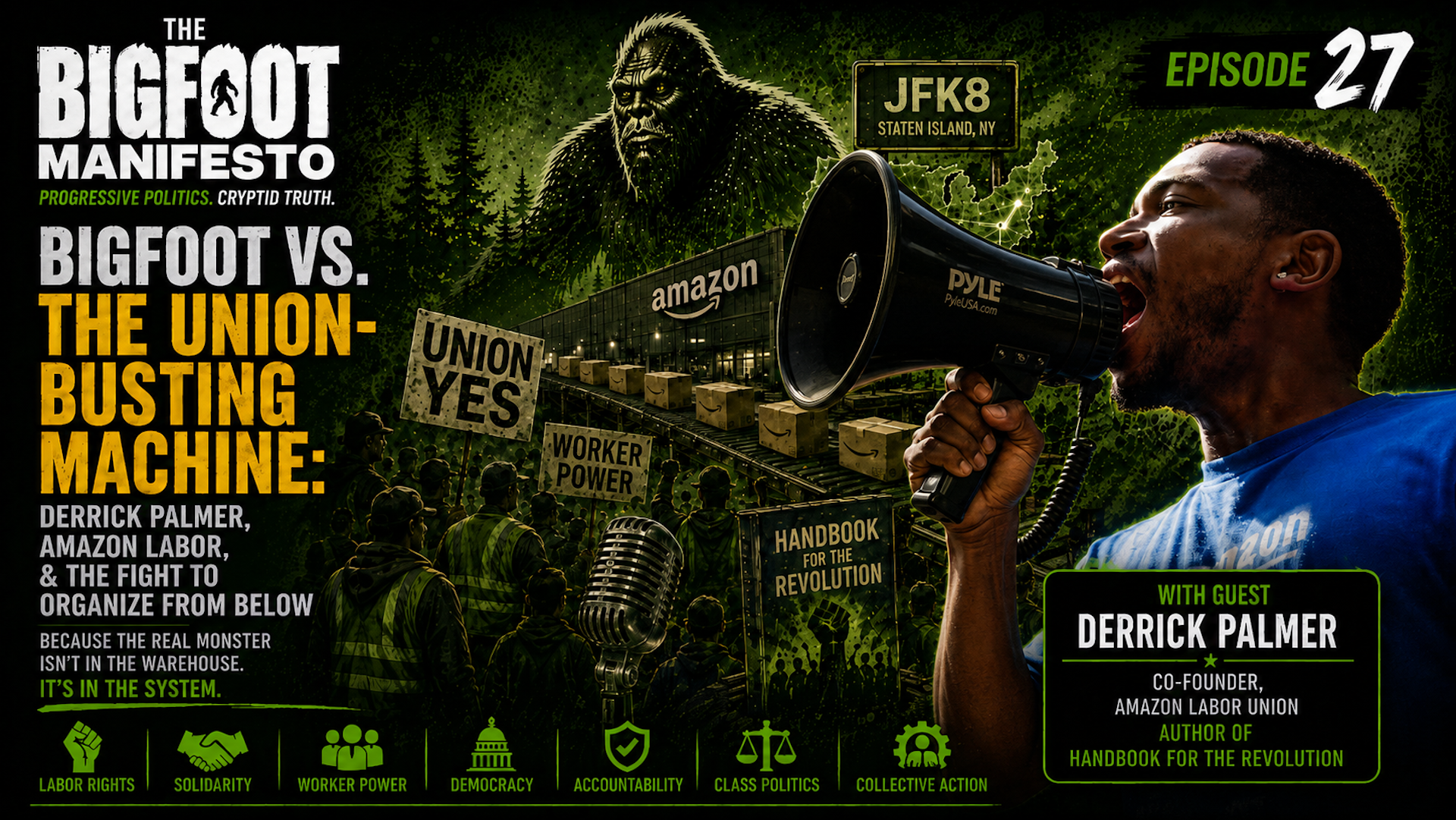
That is one of the clearest lessons from Derrick Palmer’s work organizing JFK8, Amazon’s massive Staten Island fulfillment center. Palmer, a co-founder of the Amazon Labor Union and author of Handbook for the Revolution, did not arrive as an outside professional carrying a perfect campaign plan. He was already inside the building. He knew the work, the policies, the managers, and the people expected to meet the company’s relentless productivity demands.
That knowledge mattered. But the deeper advantage was community.
Amazon could build a warehouse, design an algorithm, track every movement, and hire consultants to discourage union activity. It could not manufacture the years of trust that workers had built with one another.
The Workplace Had Already Trained Its Organizers
Before becoming a union organizer, Palmer worked as an Amazon ambassador and trainer. The role gave him relationships across the facility. Workers knew him. Many already saw him as a leader and came to him when they needed help understanding a rule or dealing with management.
The company had unintentionally helped create the social network that would later challenge it.
This is easy to miss when labor stories are told only through election results and courtroom decisions. Organizing begins much earlier. It begins when a worker helps a coworker solve a problem. It grows when people compare experiences and realize that the pressure they feel is not a personal failure. The impossible rate, the lack of time off, the injury, the unpredictable discipline, and the fear of losing a job are connected features of the same system.
Palmer’s method was direct. He talked with workers about the problem in front of them. He shared his own experience, listened for the issue that mattered most to the other person, and connected that issue to collective action.
The point was not to deliver a speech about labor history. It was to make the union real in the daily life of the building.
Fear Is a Management System
Large employers do not rely only on wages and schedules to control a workplace. They also rely on uncertainty. Workers may not know which conversations are protected, what management can see, or whether signing a union card will put a target on their back.
Palmer did not pretend that fear was irrational. He told workers the truth: management would watch the campaign, the struggle would be difficult, and victory would demand endurance. Honesty became part of the organizing strategy.
Fear isolates people. Organization breaks that isolation.
One worker can be treated as replaceable. A group of workers who act together can interrupt the machinery that makes the company profitable. That is why the most powerful discovery in any organizing drive is not that the employer is invincible. It is that the employer depends on the very people it has trained to feel powerless.
The JFK8 campaign turned that discovery into a historic result. Workers voted to form a union in April 2022, producing the first union victory at an Amazon warehouse in the United States recognized through a National Labor Relations Board election.
Winning the Vote Was the Beginning
The victory also revealed a brutal weakness in American labor law: workers can win an election and still wait years for a first contract.
Amazon challenged the union’s certification and refused to bargain. In April 2026, the National Labor Relations Board ordered the company to recognize the union and begin negotiations. Four years had passed since the election.
The delay was not a side effect. Delay is power.
It gives an employer time to exhaust organizers, change the workforce, weaken solidarity, and turn a democratic result into an endurance contest. Palmer’s experience forced a hard lesson: the law may recognize a union, but a contract still depends on organized worker power.
That means continuing to talk, train new leaders, represent coworkers, and prepare workers to act together. A bargaining order can open the door. It cannot walk through the door for them.
Mistakes Are Part of the Handbook
One reason Palmer’s story is useful is that he does not present organizing as a sequence of flawless moves. The campaign initially tried to organize more buildings than its core group could adequately support. The ambition was understandable. The capacity was not yet there.
The lesson is simple and transferable: build a committed core before expanding. Know who can carry responsibility. Map the workplace. Understand the law. Give the organization an identity. Create a way to communicate that management does not control. Then grow without outrunning the trust and leadership needed to sustain the campaign.
This is what makes Handbook for the Revolution more valuable than a victory memoir. It treats workers as strategists. It assumes that the people living inside a system can study it, test it, make mistakes, and change it.
Democracy Cannot Stop at the Time Clock
The fight at JFK8 is about wages, time off, safety, retirement, and dignity. It is also about a larger question: who gets to make the decisions that govern most of a worker’s waking life?
We are told that democracy is a defining American value. Yet millions of people enter workplaces where decisions flow in one direction, surveillance is constant, and speaking collectively can trigger a sophisticated campaign designed to stop them.
Palmer’s answer is not to wait for a heroic politician or a national organization to appear. Start with the people already there.
Worker power lives in the break room, the parking lot, the bus stop, the group text, and the conversation where one person finally says what everyone else has been thinking. The historic vote at JFK8 began in those ordinary places.
That is the part corporate power never wants workers to understand: the machinery may belong to the company, but the relationships belong to them.
Listen to Episode 27 of The Bigfoot Manifesto for the full conversation with Derrick Palmer.
Bigfoot vs. The Union-Busting Machine – The Bigfoot Manifesto