
When the last independent grocery store closes, the standard explanation sounds almost scientific: the market decided.
The phrase makes a political choice sound like weather. A local business failed. A national chain expanded. Consumers wanted convenience. The more efficient company won.
But markets do not arrive from nature. Laws determine what corporations may own, how they may price goods, whether they can discriminate among buyers, and how much power they can exercise over businesses that depend on them. The market we have is the result of those rules and the decision, sometimes, not to enforce them.
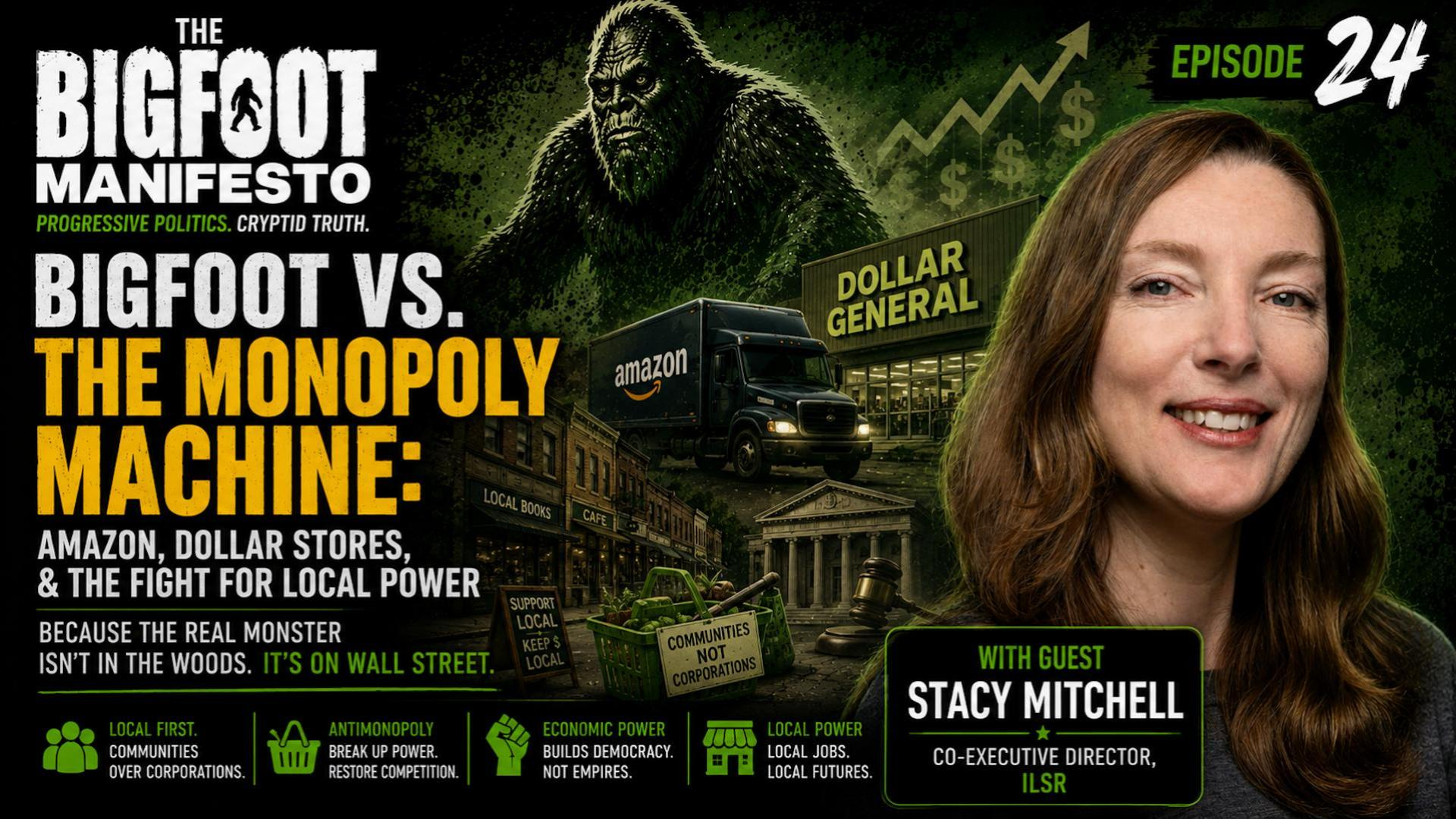
In a conversation on The Bigfoot Manifesto, Stacy Mitchell of the Institute for Local Self-Reliance described monopoly as a problem of power, not simply size. That distinction changes the entire story.
Bigger Was Made to Look Inevitable
For much of the twentieth century, antitrust policy reflected a broad concern about concentrated power. The issue was not only whether a corporation charged a low price today. Policymakers also asked whether communities retained independent businesses, workers had meaningful options, and no private company could control the infrastructure everyone else needed to reach a market.
Beginning in the 1970s and accelerating in the 1980s, a different idea took hold. Bigger corporations were presumed to be more efficient. If consolidation delivered lower consumer prices, then the loss of smaller competitors was treated as an acceptable cost.
Policy followed the theory. Enforcement weakened, corporations consolidated, and the resulting economy was offered as proof that consolidation had been inevitable all along.
It was a remarkably effective loop: change the rules to favor large firms, then point to their success as evidence that the rules did not matter.
Amazon Is the Road and a Truck on the Road
Mitchell offers a useful way to understand Amazon: it is a modern railroad.
For a business trying to reach online customers, Amazon is not merely another store. It is a gatekeeper to the market. Sellers depend on its search results, marketplace, advertising system, warehouses, delivery network, and access to Prime customers.
At the same time, Amazon competes with the businesses using that infrastructure. It can observe what sells, control which products appear, charge sellers for visibility, and offer its own competing products. It is the referee, the stadium owner, and a team on the field.
That structure turns the promise of convenience into dependency.
An independent business may technically be free to avoid Amazon and sell through its own website. But if most shoppers begin their search inside Amazon, that website can feel like a storefront on a dirt road. The seller enters the platform because customers are there. Once dependent, the seller has little leverage over fees or rules.
Research from the Institute for Local Self-Reliance estimated that Amazon collected 45 percent of third-party sellers’ U.S. revenue through referral, advertising, and fulfillment fees in the first half of 2023. The Federal Trade Commission and a coalition of states have alleged that Amazon uses exclusionary practices to maintain monopoly power in online retail and marketplace services. Amazon disputes the government’s allegations.
The important point is structural. A business cannot negotiate fairly with the company that controls whether customers can find it.
The Grocery Store Did Not Lose a Fair Fight
The same pattern appears in food retail.
The Robinson-Patman Act prohibits certain forms of price discrimination by suppliers. In plain language, a dominant retailer should not be able to use its buying power to force a supplier to charge smaller competitors more for the same goods without a legitimate cost justification.
For decades, enforcement helped independent grocers coexist with national chains. Then federal enforcement largely disappeared.
That opened the door for the biggest buyers to demand preferential terms. A local grocery store may appear more expensive at the register, but the price difference can begin far upstream. If a supplier gives a dominant chain a sweetheart deal and charges the independent store more, the local owner starts the race several yards behind.
When that store closes, the community loses more than a checkout counter. It loses a local employer, a buyer from other nearby businesses, a civic relationship, and a measure of control over food access. The chain can then consolidate locations and expect customers to travel farther.
Food deserts are often described as a problem of communities that are too poor or too small to support a grocery store. Mitchell’s argument reverses that assumption. Many communities spend enough on food. The problem is that independent stores have been denied a fair opportunity to serve them.
Convenience Has a Political Cost
None of this requires pretending that national retailers offer no benefits. Delivery is useful. Low prices matter. A broad product selection can improve daily life.
The problem begins when convenience becomes the only value used to judge an economy.
A cheap product today may conceal a larger bill: fewer employers, lower supplier power, weaker local tax bases, less resilient supply chains, and no meaningful alternative when the dominant company changes its terms.
Competition is not the presence of several logos on a screen. It requires businesses that can actually survive, reach customers, and negotiate without being punished by a gatekeeper.
Local Power Is Democratic Power
Mitchell’s work connects economic concentration to democratic decline. When more decisions are made in distant corporate boardrooms, people experience the economy as something imposed on them. Their town cannot protect its grocery store. A seller cannot appeal an automated suspension. A worker cannot negotiate a schedule. A community watches money leave and authority follow it.
That powerlessness does not remain confined to shopping or work. It shapes whether people believe democratic institutions can still affect their lives.
Rebuilding local economies is therefore not nostalgia for a picture-perfect Main Street. It is a project of distributing power.
That can mean enforcing antitrust law, separating a dominant platform from the businesses that compete on it, reviving rules against discriminatory supplier pricing, supporting community banks and local ownership, and giving states and cities tools to protect competitive markets.
The goal is not to freeze the economy in the past. It is to create room for more futures than one corporation would choose for us.
Monopoly power rarely hides. It is visible in the empty storefront, the seller fee, the warehouse scanner, the missing grocery store, and the algorithm deciding which business a customer will see.
The question is not whether the market produced that result. The question is who wrote the rules.
Listen to Episode 24 of The Bigfoot Manifesto for the full conversation with Stacy Mitchell.